
Dev Blog #2: The Climb: Skilling up in Rhizome
Introduction:

Levelling up a character is one of the most quintessentially enjoyable parts about RPGs, and is arguably their most defining feature. The gradual feeling of progression is one of the primary axes of the gameplay loop baked into these types of games, but getting it right can be pretty difficult. The way progression manifests can be multi-faceted in RPGs and include social standing and the strength of one's equipment, but almost always involves improving the skills and attributes directly attached to the character themselves, as well.
This blog will be discussing the latter.
Levelling in a levelless world:
The currency of progression in the most classic RPGs is experience -- kill a slime, that's worth 10. Goblin? 25. Ancient dragon? Cool 5,000. Each level you gain, the amount of experience you need to go to the next rises exponentially, meaning while you can theoretically kill slimes to get to level 99, at some point it does become more economic to try to kill god. The point is, by making harder things give more experience, and making each level cost more than the last, developers can force players to push themselves on to harder and harder content if they want to see their characters move up. This roughly mimics real life -- if you can bench 135, you need to eventually try 140 to get stronger.
Eventually, it became apparent the experience system left a lot to be desired. Killing a dragon paid into a general pool of experience that made you better at everything. In a game where the only thing you could do is kill things that's great, but in a full simulation game, killing a dragon could suddenly make you better at cooking, or singing, or forging a sword.
The solution was to make games where exercising a skill improved that skill alone, meaning you had to practice a skill specifically to get better at it. This was more immersive, but opened up a huge can of worms when it came to players finding risk free, effortless ways to level skills to max. I still have fond memories of repeatedly pickpocketing Pemenie in Morrowind to maximize sneak with no chance of failure. Quirks like this are funny and memorable in a single-player series like the Elderscrolls, but can cause really heavy balance issues in an online game, so most MMOs either use experience, or try to find a way to pin skill-use based improvement to the challenge of the task.
MUDs aren't different, but finding an adequate way to set difficulty has proven really tough historically. The most common way of doing this was to tie skill improvement to failure, with the assumption being that you could only possibly fail a task that was too hard for your character to pull off. This worked reasonably well, but led to strange behaviors in players attempting to maximize their chances. Paradoxically, this system provides perverse incentives to make your character as temporarily bad at something as possible in hopes of failing an otherwise easy task for the sake of training. Failure becomes the goal itself -- spar while drunk, craft in pitch blackness, try to be stealthy while wearing heavy armor, and so forth, and you'll get really good even though you're risking nothing and really wouldn't learn anything from doing that stuff anyway.
Rhizome does things a bit differently.
How tough are ya?
In Rhizome, we explicitly define challenge numerically; almost every skill is opposed by something, and that something can be expressed in a number. I'll be using combat skills as an example here, but know that this principle extends to everything. Every NPC and player character in Rhizome has what is called a 'lethality' score. For characters, it's the average of your offense and your defense. For NPCs, it's set manually, in order to reflect their unique biology making them more or less dangerous than those two skills might imply. Every combat skill in Rhizome will only train if your opponent has lethality sufficiently close to the skill you are practicing.
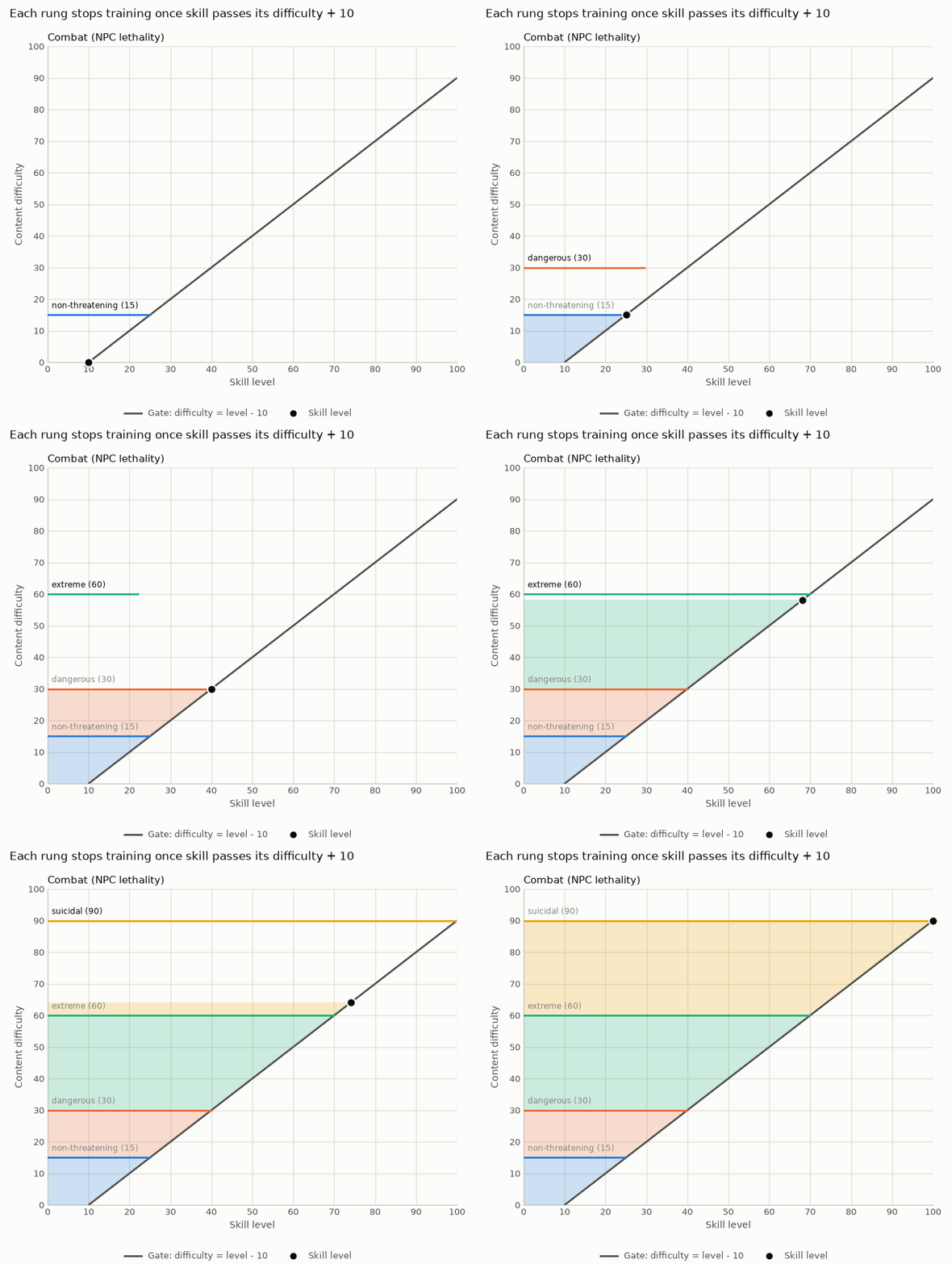
You can only train so high in a combat skill against something weak -- you will eventually have to find greater and greater challenges in order to continue to get better at fighting. This applies to every skill in Rhizome. Want to get better at stealth? Better find someone or something good at spotting you and practice against them. Better at crafting? You'll need to craft something of a quality no less than ten below the craft skill you're working on -- spamming junk crafts won't do it. Swimming? Deeper and deeper water. Climbing? Higher and higher cliffs. It's the same principle. Push yourself to grow.
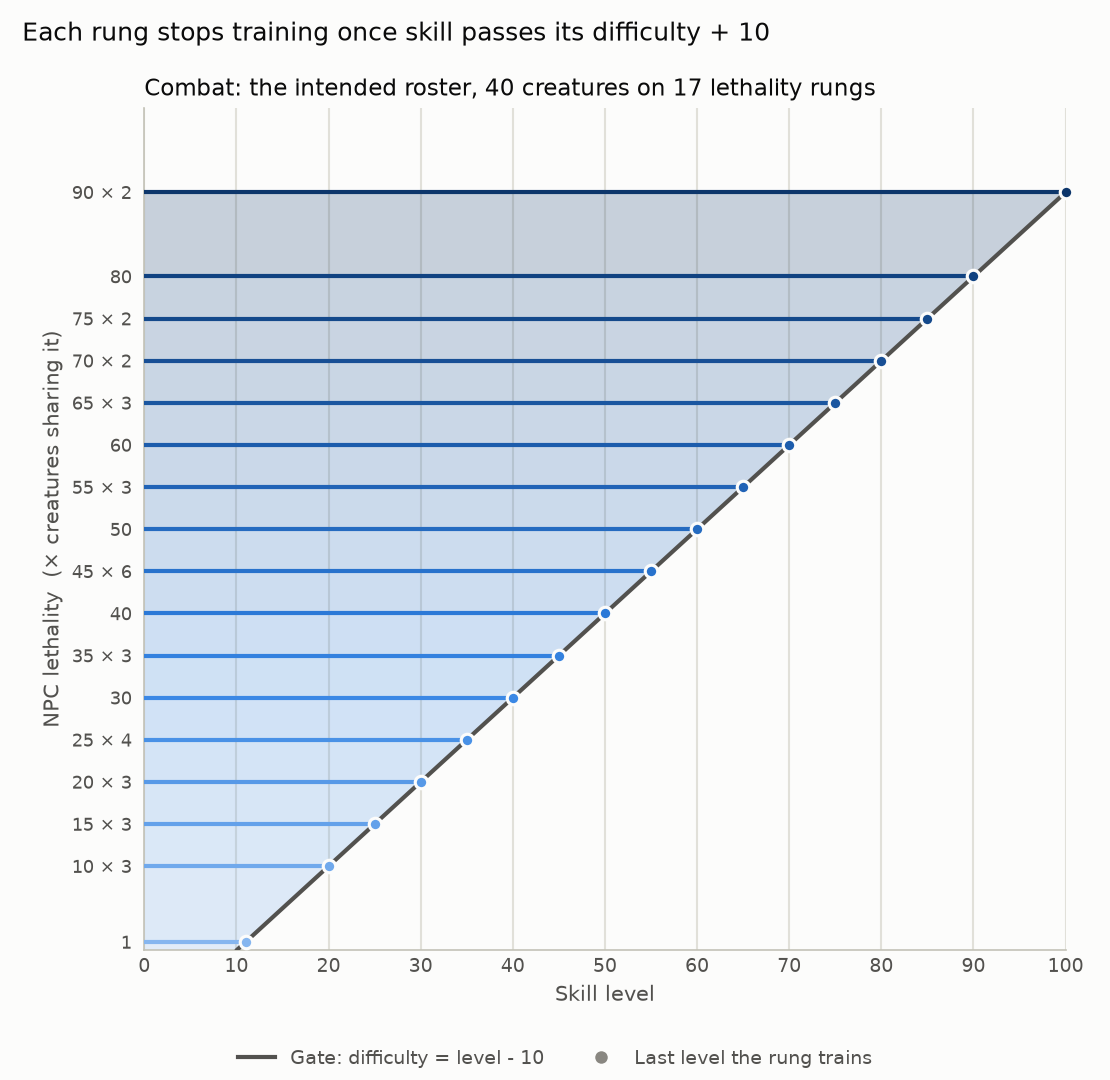
If you're worried the animated example above looks a bit sparse, here's what the actual alpha distribution of NPC wildlife difficulties looks like:
How to exercise:
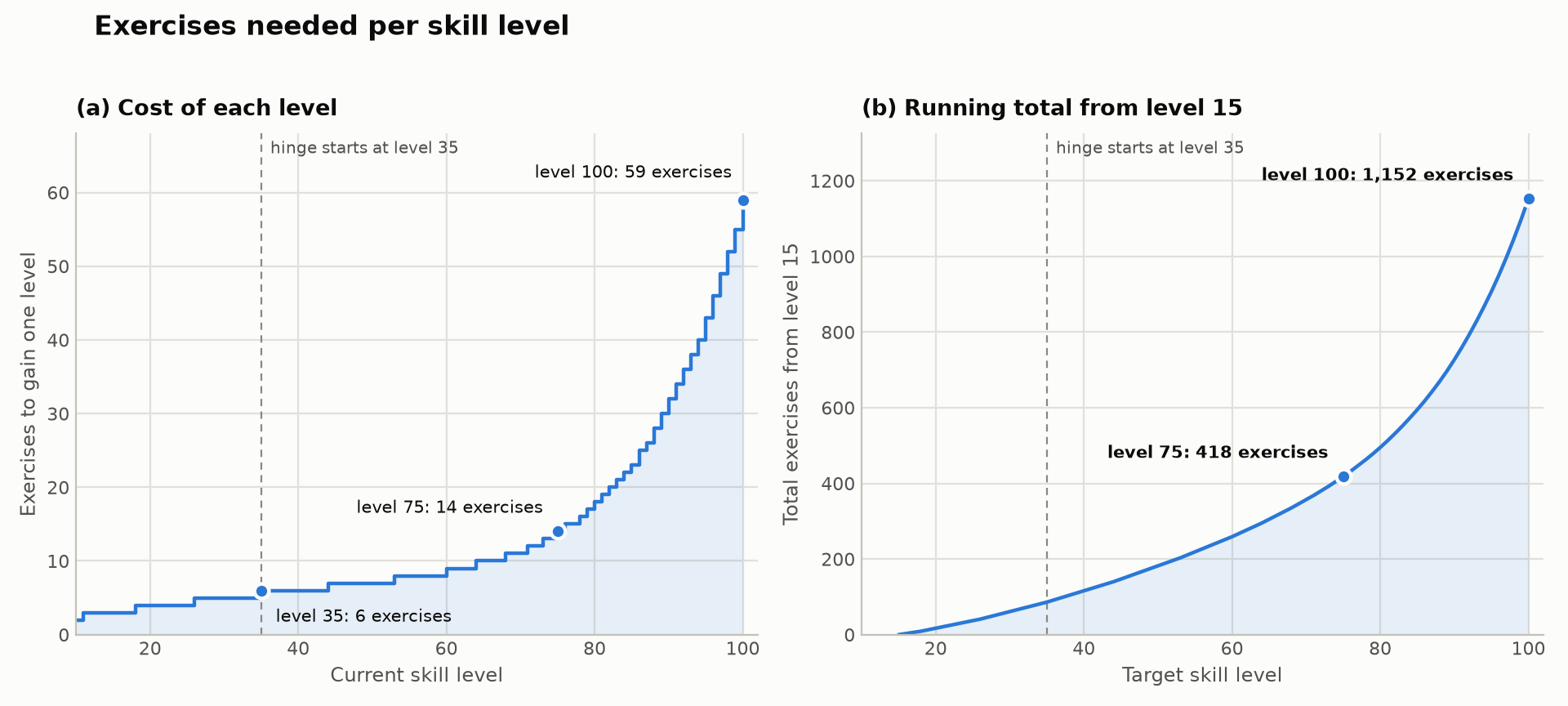
Skill exercising in Rhizome is based on the stats that govern the skill. Every time you successfully train a skill, that skill is 'exercised' and goes on cooldown. The number of exercises a skill takes to increment a level increases as the skill improves, meaning that it takes more to level from 75 to 76 than it did from 15 to 16. There's a hinge around 35 that ramps the deceleration -- we'll get back to that later.
The time it takes between cooldowns is exactly one hour if you have 50 in both the primary and secondary governing stats, but you cool down much faster with higher stats (or slower with lower), meaning having high stats in the skills you want is helpful for learning them faster.
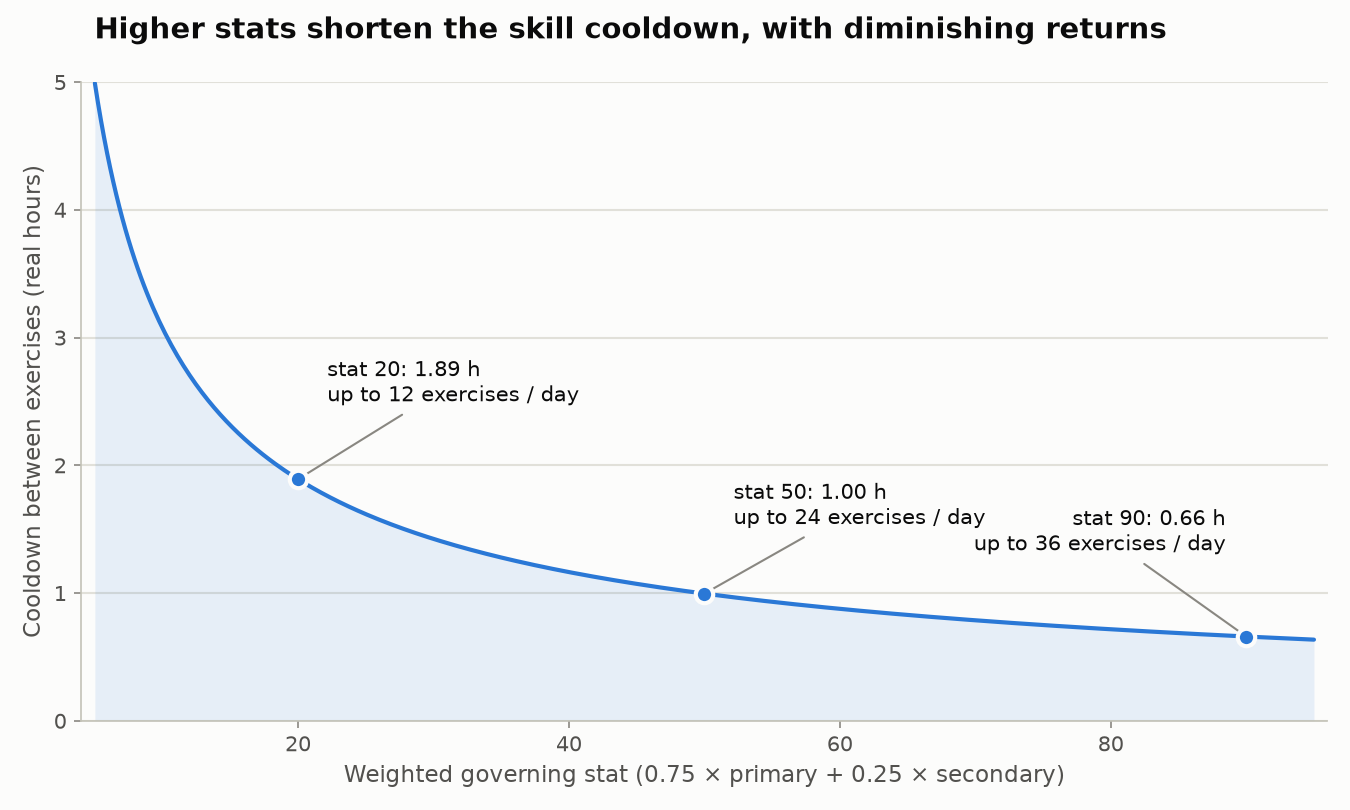
For other plots on this page, assume everyone has 50/50 in the relevant stat.
Growth curves:
Another really important part of setting up a skill system like this is finding a sweet spot in how long everything takes. Too long, and you'll frustrate people. Too short, and it feels unearned. You also can risk really inflating the role of playtime, driving a massive gap between your hardcore time-sink players and your casual players who might only play an hour a day. Here's how Rhizome handles it. Keep in mind that this growth chart assumes everyone is hitting their cooldowns whenever they are online and those cooldowns are available.
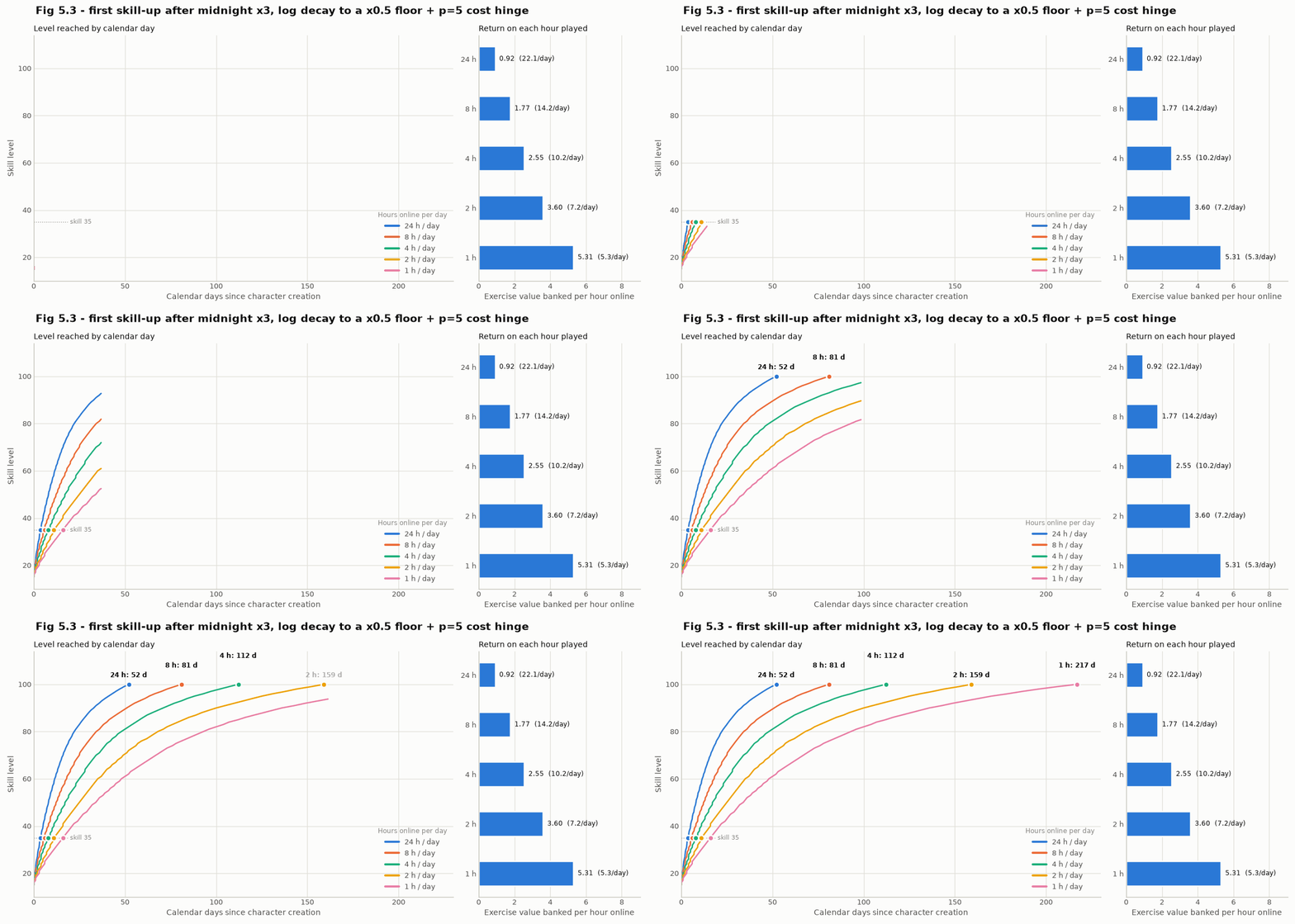
Around skill level 35 is what we consider 'competency' in a skill -- you're not likely to fall on your face and embarrass yourself anymore. It's important that characters reach competency relatively quickly, so they don't feel underpowered. Rhizome provides a bonus to the first skill exercise of each skill per day, with diminishing returns thereafter until midnight server time.
Players playing more will still level faster, but it's blunted by this system: a hardcore 8-hours a day player reaches competency in six calendar days, but a player playing eight times less as them reaches the same point in a little less than three times that. At high levels, the difference between the two become more noticeable, with the 8-hour-a-day grinder hitting max level when the casual one hour player sits around 75 in the skill, but that seems a fair reward for dedication.
Note that the 24 hour a day play is not expected -- anyone doing that is either botting, or a literal robot IRL.
A fall from great heights:
"But wait!" I hear you say. "I am an eight-hour-a-day power leveller. Am I only going to get to enjoy my favorite part of an RPG for less than three months if I play Rhizome?"
Well, no, there's other systems you can use to continue progressing, but you have a much bigger problem. In Rhizome, because we force you to pursue greater and greater challenges to skill up, the unspoken continuance of that thought is that the risk is greater and greater as well. Most of the time, the climb doesn't end because you summit the mountain... it's because you go careening off into a crevasse, die, and have to start over. Let's use literal climbing to illustrate that point.
At a climb level of 50, you need to attempt to climb into a room with a fall distance of at least four rooms below it in order to exercise your climbing skill -- a reasonably high climb, actually. I'll discuss the actual mechanics of traversal in a later post, but for now let's take a look at 30 climb attempts at 50 climb skill, and see how often we fall off the cliff and how bad it hurts when we do.
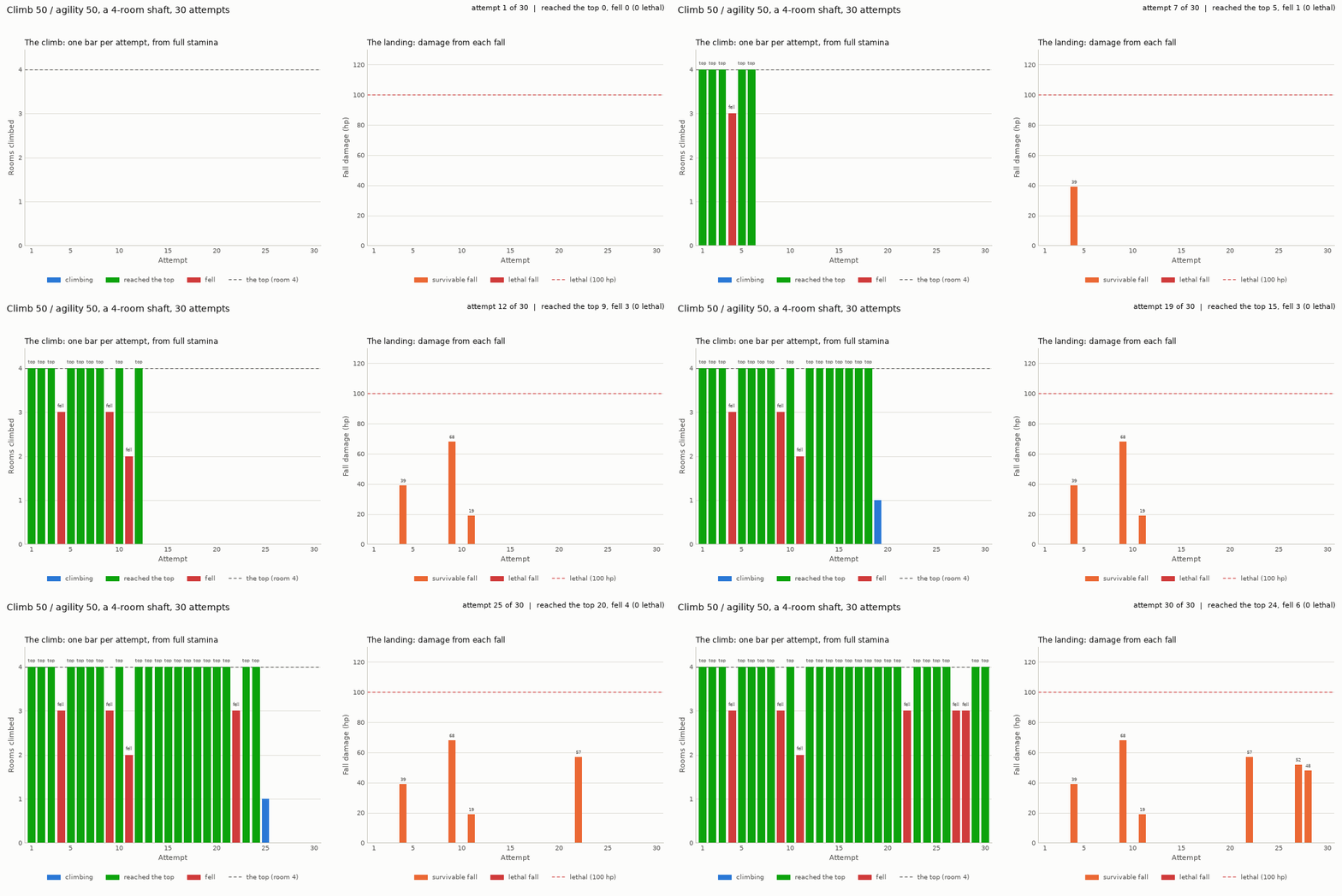
Okay, not too bad, we fall about 20% of the time, but that means we make it 80%! Keep in mind this is not factoring in things like using crampons or ropes to improve your chances; this climber is a member of the yolo school of the craft. Even when we fall, it's not like it kills us. Okay, fine, taking 68 points of damage when you're potentially falling into a hostile jungle isn't the most comfortable position to be in, but you're not dead outright from the fall at least.
Let's see what happens when a much more advanced climber has to take a crack at something even higher in order to exercise.
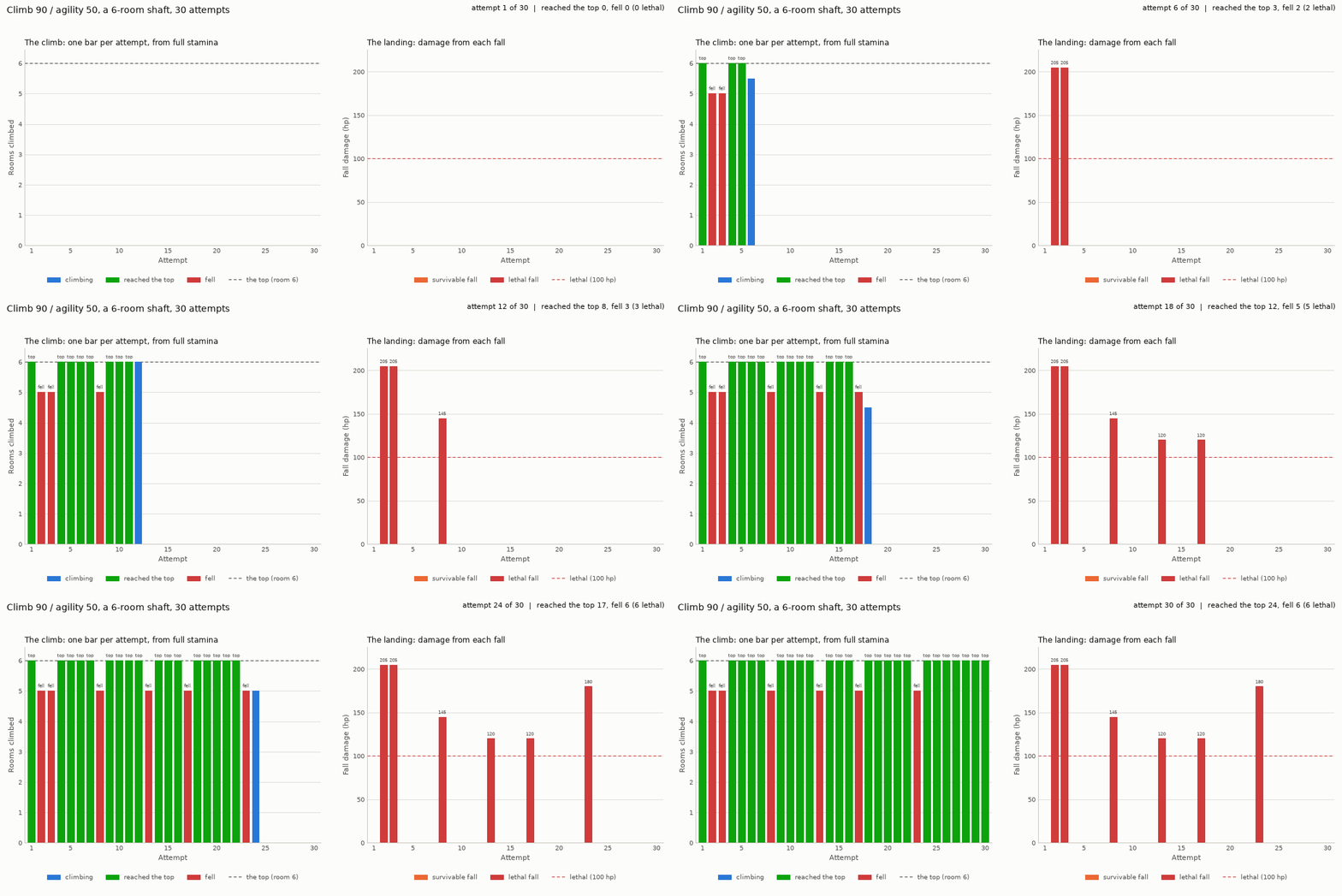
Oof, that's a lot of crumpled bodies at the bottom of the cliff. Again, this climber is being ridiculously reckless. There are ways to mitigate falling if you're intelligent. You could climb down from the top instead of up from the bottom so when your grip fails you're not falling from so high. You can climb over water or soft sand so the impact doesn't hurt too much. You can give up half way and turn back when you realize this attempt isn't it. But the point being is, each one of those bright red smeary bars is a reset. It's going to take a long hard road to get to 100 climb and if you lose focus or take unnecessary risks along the way, you won't make it. We expect the majority of characters to die trying.
And that's the best part. The skills your character have are the records of your triumphs. If you meet someone with 100 climbing skill in the game, you know they're a badass. They risked it so many times, knew what to do so many times, got lucky so many times, and won. In Rhizome, an old veteran in a young man's profession is truly something to be feared.
Thank you for reading!